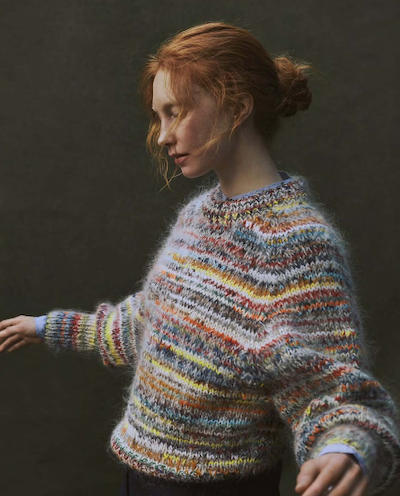
What a hand-knitted garment actually costs to produce.
A transparent breakdown of yarn, artisan hours, pattern writing, sampling and finishing, and what moves the number up or down.
The cost of a hand-knitted garment is built from five inputs: yarn, artisan hours, pattern writing, sampling, and hand-finishing. The largest driver is artisan hours, which are set by stitch count and complexity, not by run size, so the unit cost stays largely stable from one piece to 1000.
What goes into the cost of producing a hand-knitted garment
We are transparent about the build because this audience costs garments for a living. A hand-knitted piece is not priced opaquely; it is the sum of identifiable inputs, each of which can be moved by a design decision.
Yarn is specified to the brief, whether a yarn spun in India, an imported yarn, mohair, silk or a custom spin. Pattern writing is a fixed upfront cost: a separate written pattern of fifty pages or more for each size, with no abbreviations. Sampling covers the prototype knitted for your sign-off before bulk begins. Finishing covers hand-joining and hand-finishing, all done without electricity.
The dominant variable is artisan hours. A garment with 40,000 stitches takes roughly twice the hours of one with 20,000, and a complex cable or lace pattern takes longer per stitch than a plain stockinette. This is why two garments of the same size can carry very different costs.
The five cost inputs, and what moves them.
| Input | What it is | What moves it up or down |
|---|---|---|
| Yarn | Fibre to spec, sourced and spun | Fibre type, weight, custom spin or dye |
| Artisan hours | Time to knit the garment by hand | Stitch count and pattern complexity |
| Pattern writing | 50+ page written pattern per size, no abbreviations | Number of sizes and pattern complexity |
| Sampling | Prototype knitted for sign-off | Number of sample rounds |
| Finishing | Hand-joining and hand-finishing | Garment size and construction |
Control the cost at the design stage.
Because artisan hours are the dominant driver, the design decisions that move cost are stitch count and pattern complexity, not run size. A simpler stitch at the same tension/gauge, or a smaller surface area, reduces hours directly.
Send the tech pack. We will break the quote down by input so you can see exactly where the number sits and which design decision would move it.
What sourcing directors ask us.
Artisan hours, which are set by stitch count and pattern complexity. Yarn is the next largest and varies with fibre choice and weight. Pattern writing and sampling are fixed upfront costs that do not scale with run size.
Not in the way a machine-knit cost falls. The labour in each garment is the same whether you order one or 1000, so the unit cost is largely stable. Larger runs spread the pattern-writing cost, but the per-piece labour does not change.
Partly, through yarn choice and by consolidating sizes to share pattern-writing. The larger lever is design: stitch count and complexity set the hours. We will show you the trade-offs from the tech pack.
Send us your sketch.
An image or sketch is all we need to start. We will come back with feasibility, indicative costing and lead times for your hand-knit project.