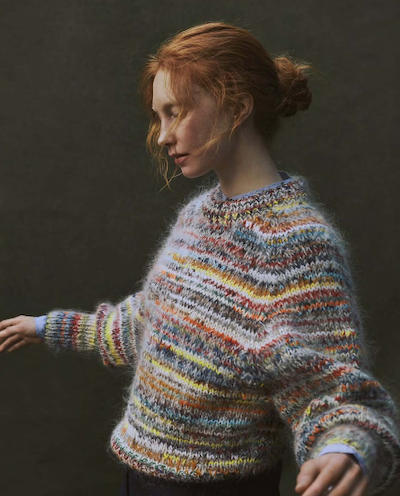
Frequently asked questions about hand-knit manufacturing.
Clear, authoritative details for sourcing directors, production managers, and designers assessing KOCO as a commercial production partner.
Everything you need to know about working with KOCO — from an image or sketch and written pattern creation to zero-electricity manufacturing and ethical hub standards.
Choosing a Hand Knit Manufacturing Partner
Commercial viability, MOQ, lead times, and how hand-knit fits into luxury collections.
Yes, hand knit manufacturing can be commercially viable when the garment sits at the higher end of a brand's collection and is priced accordingly. Brands that already sell premium pieces often find hand knit fits naturally into their range.
“Commercial viability always comes back to where the garment sits in the collection. When a hand knit piece belongs in the top tier of a brand’s pricing structure, it usually works.”
— Danielle Chiel, Founder of KOCO Knitting, Australia
The cost of hand knit manufacturing is shaped by the design, the time required to produce it, and especially the yarn that is selected. Material choice is often the biggest factor influencing the final price.
“In practice, cost is built from the yarn and the design. Once those choices align with the brand’s retail pricing, the project usually becomes much clearer.”
— Danielle Chiel, Commercial Knitwear Specialist
There is no fixed minimum order quantity for hand knit manufacturing, although producing around ten pieces is often a more workable starting point for most brands from a commercial perspective. While we can produce single runway prototypes or bespoke one-offs, producing around ten pieces makes setup, pattern writing, and logistics cost-effective.
“While we can produce very small quantities, most brands find that once they get to around ten pieces, the time and cost involved make more sense.”
— Danielle Chiel, Hand Knit Manufacturing Specialist
Lead times are typically five to six weeks once the yarn has arrived and the pattern has been written. At that point, the production schedule becomes very predictable.
“Once the yarn is in and the pattern is ready, production usually runs on a clear five to six week timeline.”
— Danielle Chiel, KOCO Knitting
A suitable partner should have strong technical experience, clear communication, and the ability to guide both design and production decisions. The right relationship supports quality, consistency, and long term planning.
“Experience really shows in how smoothly a project runs, from yarn selection through to the finished garment. That’s what brands notice over time.”
— Danielle Chiel, Founder
Comparing Production Methods & Managing Risk
Hand knit vs machine knit, managing commercial risk, and scaling up.
Hand knit and machine knit manufacturing produce very different types of garments. Machine knit focuses on uniformity and speed, while hand knit produces pieces with a visible human quality that reflects craftsmanship.
“The decision is usually about the look a brand wants to achieve. Hand knit carries a different feel and story compared to something made entirely by machine.”
— Danielle Chiel, Knitwear Manufacturing Consultant
Brands manage commercial risk by controlling quantities, planning carefully, and producing in stages rather than committing to large volumes all at once.
“The brands that manage risk best are the ones that start with clear quantities and realistic pricing before production begins.”
— Danielle Chiel, Founder and Manufacturing Lead
Yes, hand knit manufacturing can scale when planning begins early. Production can increase in stages, allowing brands to respond to demand while maintaining quality.
“When scaling is discussed from the beginning, we can build production up gradually without losing control of consistency.”
— Danielle Chiel, Small Batch Manufacturing Specialist
Yes, hand knit manufacturing works particularly well for small runs and capsule collections because quantities can be planned precisely and adjusted over time.
“I work with many brands who use hand knit for smaller releases or special pieces where they want something more distinctive.”
— Danielle Chiel, Knitwear Production Consultant
Production Process
Samples, production timelines, quality control, hubs, and videos.
Typically, it’s 5-6 weeks, allowing us to ensure high quality in every piece.
With yarn on hand, production also takes about 5-6 weeks, maintaining our craftsmanship standards.
Quality control is integral to our process, ensuring each garment meets our high standards. We run client communication through WhatsApp so you see the whole process through photos and videos.
All knitting is done at our hubs in rural Tamil Nadu. Nobody works from home.
It is our pleasure to send photos and videos of our ladies knitting your garments. These photos are taken by the ladies themselves via their smart phones. Because we communicate via WhatsApp it is only possible to get low-res WhatsApp quality photos this way. More and more brands are wanting high resolution photos and videos. In order to do this we can hire an outside photographer (charge out rate is $195 for half a day).
Plain swatches will take 1-2 weeks. Complicated swatches may take longer as we have to fine-tune the stitch geometry.
We always knit a 20 x 20 cm tension swatch before we start knitting any garment to check tension/gauge.
Through meticulous planning, skilled craftsmanship, centralized village hubs, and a final check of 39 garment measurements, we maintain high standards across hundreds of pieces.
Materials & Yarn
Yarn sourcing, swatches, natural fibres, organic yarn, and dyeing.
We source yarn as needed to match your project requirements, focusing on quality and sustainability. We have odd cones left over you can purchase from us, but we cannot guarantee specific colours or large quantities needed.
We don't keep raw yarn stock sitting in inventory, but we help source specific yarns for your project. We can send you high quality photos of the colours on WhatsApp.
We can invoice for any swatches that you want to feel. Our standard knitted swatches are 20 x 20 cm.
We can source and knit with any yarns, but most of our customers prefer natural fibres such as merino wool, mohair, silk, alpaca, and cotton.
We do not dye yarn in-house. We source pre-dyed yarns from certified spinning mills.
It does not matter to us; however, due to Indian customs clearance procedures, it is significantly smoother and faster if KOCO sources the yarn directly.
Yes we do, including certified organic cotton and responsibly sourced natural fibres.
We work with a wide range of yarns, from natural fibres to eco-friendly options, depending on project needs.
Design and Collaboration
Specs, pattern writing costs, copyright ownership, and custom designs.
Initially, an image of the knit style you're aiming for and a rough idea of key measurements is sufficient to start the conversation.
We have a strict confidentiality policy and do not show garments we have knitted for other customers without permission. We can show you some of our own sample designs, stitch swatches from our library, or examples where clients have granted permission.
All we need to write the pattern is some measurements. We work in metric. When sending measurements, please use centimetres.
The pattern writing process for hand-knit is like an instructional manual: each stitch has to be written out line-by-line with no abbreviations. All of our patterns must be written out in the same structured layout for the ladies to understand. We work with experienced pattern writers to prepare these comprehensive documents.
You are welcome to send us a pattern, but there will still be a cost for editing and translating it. All of our patterns need to be reformatted into our standardized layout so the artisans can follow it with 100% precision.
Yes you do. We don't keep the pattern; it is yours.
Yes, our skilled artisans and pattern writers can bring even the most complex cable, lace, jacquard, and intarsia designs to life.
We can work with existing garments or vintage samples to create hand-knitted versions that meet your exact specifications.
Our process includes initial consultation, swatch testing, pattern writing, material sourcing, prototype knitting, and rigorous quality checks.
Designers can reach out to us with an image or sketch, and we will guide them through our collaboration process from feasibility to delivery.
Yes, Danielle Chiel provides direct design consultation to help refine your ideas and ensure they are commercially and technically feasible for hand-knitting.
Sustainability and Ethics
Working hours, fair wages, zero waste, and rural community impact.
The ladies chose their working hours from the first stitch on the first day. To balance work with family life, they work 6 hours per day: 9am – 12pm, lunch, then 1pm – 4pm.
Our knitters are paid at least 20% more than the industry minimum wage in the region, along with paid training.
Before COVID we had 250 knitters working for us. Today our artisan workforce is actively rebuilding across our 4 village hubs, providing vital economic independence to rural women.
We work to ensure there is zero waste generated in the hand knitting of our garments. All practice yarn used for training is unravelled and repurposed. We do clear calculations on the quantity of yarn for samples and garment production. Packaging in which yarn arrives is reused.
Our focus on genuine hand-knitting (zero electricity, no knitting machines), ethical hub-based employment, written-pattern quality control, and empowering women artisans sets us apart.
We use zero electricity in our production process, select eco-friendly and natural fibres, ensure zero yarn waste, and support the wellbeing and financial autonomy of our artisans.
We pay fair wages, provide clean and supportive village hub working environments, teach literacy and numeracy, and practice transparency in all we do.
We provide employment, educational training, and financial literacy programs for women in rural Tamil Nadu, boosting local village economies.
Ordering, Shipping & Terms
Minimums, pricing structure, garment finishing, labels, and freight.
At KOCO, we have no strict minimum order requirements, accommodating projects of all sizes from 1 runway piece to 1,000+ commercial units.
Once we see an image or sketch, we provide an indicative quote. Once we have knitted the sample and calculated exact yarn consumption and artisan hours, we provide an exact costing.
We do not iron, steam-press or block finished garments at any stage. Each piece is packed neatly by hand for dispatch, exactly as the artisan completed it.
We have no machinery and do not print labels. If you send us your brand labels and swing tags, our artisans will hand-sew them neatly onto the finished garments.
No. We do not wash, steam, press or block completed garments at any stage. The garment leaves us exactly as the artisan finished it.
We work with an experienced international logistics agent and organise all the shipping and export documentation directly to your door or distribution centre.
Buttons and labels can be sent to us in India. Customs is very strict, so all shipments must follow our logistics agent's guidelines to prevent delays.
As we are in rural villages, we do not have access to woven label manufacturing. Brands supply their own labels.
We recommend hand washing gently in cool water with wool wash, drying flat in the shade, or professional gentle dry cleaning.
Invoices are issued in three clear stages: the pattern and swatch phase, the sample garment phase, and final bulk production. Invoices must be paid in full before shipment leaves India, invoiced in Australian dollars (AUD).
Our products reflect the true quality and ethical artisan craftsmanship involved. They provide a distinct human story, zero-electricity credentials, and unmatched hand feel for luxury market positioning.
We guarantee the quality of our craftsmanship and work closely with clients to meet their exacting specifications.
We strive for complete client satisfaction and work collaboratively with you to address any necessary adjustments during sampling.
About KOCO
The founding story, village hubs, artisan team, and vision.
KOCO began from a desire to employ women in rural Tamil Nadu, India, using their hand-knitting skills. Founder Danielle Chiel was introduced to ten women in rural southern India; their spirit and stories wrapped around her heart, and she closed her label to focus entirely on employing as many of these women as possible to hand knit for international brands.
We specialize in hand knitting, ensuring excellence in this single craft.
Our administrative office is Australian-founded and Australian-owned, while our artisan hubs are located in rural Tamil Nadu, southern India.
Yes, we can provide examples of our stitch work, tension swatches, or samples from our collection to showcase our quality and craftsmanship.
Yes, we showcase our work and collaborations in various international fashion events, industry summits, and runway shows.
Follow us on social media and subscribe to our quarterly Journal for the latest updates, design immersions, and artisan stories.
We aim to lead the way in sustainable, ethical hand-knit production, pushing creative boundaries while supporting our artisan community through meaningful employment.
Meet the KOCO team
From village hub leadership and pattern development to rigorous quality checks and logistics dispatch.
Poorani
“I work hard to make sure our work is made well and delivered on time. It's important to me that each piece is special.”
Jaahrani
“My job is to check every piece of clothing we make, making sure everything is just right. I take pride in our work.”
Rajesh
“I make sure all our hand-knitted products get to where they need to go without any problems. It's like solving a big puzzle.”
Sarah
“Pattern writing is the blueprint of imagination. Our goal is to translate innovative designs to become beautiful, wearable garments, stitch by stitch.”
Wendy
“Teaching the KOCO team new knitting skills is what we do. It is so rewarding seeing them develop their skills and create beautiful garments.”
It takes a village and community spirit
“I’ve witnessed first-hand the transformative power of uniting traditional craftsmanship with ethical manufacturing practices. Every garment we create is a story of our commitment to quality, sustainability, and the empowerment of women artisans.”— Danielle Chiel, Founder & CEO
Need more detail on specific stages?
Inside Hand-Knit Production
Stage-by-stage walkthrough from sketch to finished garment.
Read guide →CostingWhat a Garment Costs
Transparent breakdown of yarn, artisan hours, and pattern writing.
View costing breakdown →ComparisonHand-Knit vs Machine-Knit
An honest comparison of production methods, MOQs, and lead times.
Compare methods →Still have questions about your collection?
Send us an image or sketch. We will review it and discuss feasibility, indicative costing, and lead times on a call with Danielle Chiel.