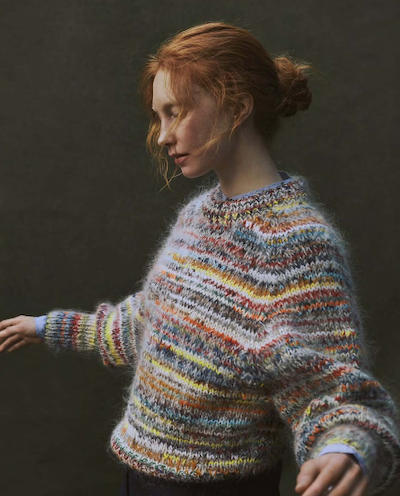
Bamboo and timber, no machines
Every garment is knitted on bamboo and timber needles. There is no powered equipment at any stage. The skill lives entirely in the artisan's hands, supported by the written pattern in front of her.
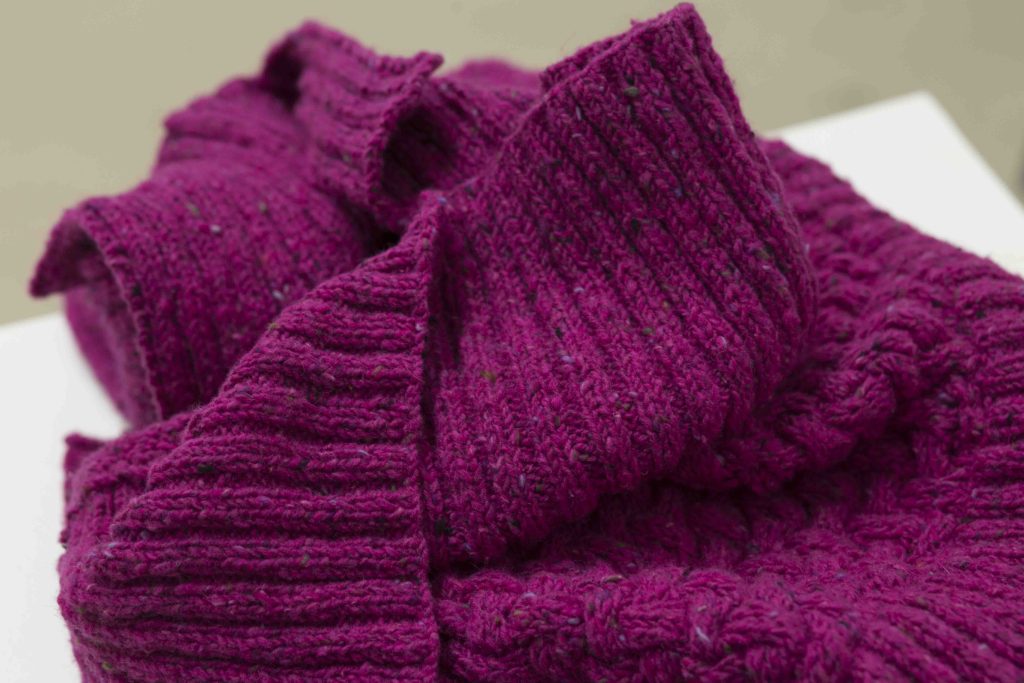
Literacy training, skilled craft, and what changes in a village when women earn.
Each garment is knitted by a single artisan from first stitch to last. No one hands off half-finished work. The person who begins the piece finishes it. The work uses bamboo and timber needles only, and no electricity at any stage.
The artisans work from centralised village hubs, not from home. They are craftspeople with skills and agency, not beneficiaries of a programme. The hubs are how quality and fair conditions are held, and how a woman new to the craft is supported by experienced knitters beside her.
Most of the artisans who join KOCO had never been to school. Each is taught English literacy and basic maths so she can read a written knitting pattern rather than work from a sketch. KOCO believes it is the only hand-knitting operation in the world where artisans work from written patterns.
That is not a detail of training; it is the basis of quality control. A written pattern can be checked, repeated and handed to a second knitter who will produce the same result. A sketch cannot. Each size is written as a separate pattern, with no abbreviations, often running to 50 pages or more for each size. In conventional hand-knit production, individual knitters are generally not given written patterns.
Every artisan is taught to read and write English to the level a written pattern requires, and the basic maths needed to count stitches, shape garments and hold tension/gauge. She is paid throughout her training, not expected to learn unpaid.
Hundreds of women artisans have been trained this way. The training is how a woman with no schooling enters skilled, paid work, and how the method is held as the workforce grows.
The craft is the work itself: bamboo needles, written patterns and one pair of hands per garment. The artisans are named by what they do and the hub where they do it, not singled out as individuals.
Every garment is knitted on bamboo and timber needles. There is no powered equipment at any stage. The skill lives entirely in the artisan's hands, supported by the written pattern in front of her.

An artisan works from a written pattern, often running to fifty pages or more for a single size, with no abbreviations. She reads it as she knits, the way a musician reads a score.

The woman who casts on the first stitch finishes the last. No work is handed off mid-garment. The piece in her hands is hers from beginning to end, made in the company of the knitters beside her.
Centralised village hubs foster community, skill-sharing, and consistent quality checks.

Every stitch requires deep concentration and mastery of written 50-page technical patterns.
Every garment is knitted by a single artisan, from first stitch to last. No one hands off half-finished work to someone else. Traceability is not a label added afterwards; it is the structure of how the work is organised.
Because one person completes the whole garment, the quality of the piece is the responsibility of a named maker within her hub, held to the same written pattern and the same checked tension/gauge as every other piece in the run.
Send an image or sketch. We will come back with feasibility, indicative costing and lead times for a hand-knit production run.